Ayurveda: An Ancient Science of Living Well
Ayurveda may sound unfamiliar, but it is considered one of the oldest comprehensive systems of health in the world. Written texts date back roughly 5,000 years, with earlier roots believed to come from ancient oral and shamanic traditions.
Much of Ayurveda was originally passed down through poetic phrases called sutras, meaning “threads.” These threads were intended to be woven into daily life, not used occasionally, but practiced consistently.
Ayurveda is often translated as “The Science of Life.”
Not the science of disease.
Not the science of symptoms.
It is the science of how to live.
Modern medicine is extraordinary and often lifesaving, but today it is frequently the first place we turn when managing physical or mental symptoms. Ayurveda does not replace modern medicine. Instead, it can complement it.
One of Ayurveda’s core ideas is equilibrium and balance in life and health. Taking a nature-based approach, Ayurveda asks a deeper question: what is the root cause of imbalance, and how can we support the body’s natural response and guide it back to harmony?
Ayurveda also recognizes that no two people are the same. Individuals digest food differently, process stress in unique ways, and experience illness differently.
Rather than treating the masses with identical solutions, Ayurveda focuses on the individual by considering lifestyle habits, sleep patterns, food preferences, work routines, emotional tendencies, relationships, and environmental influences.
Ayurveda does not ask people to change everything at once. Instead, it encourages adopting practices gradually. Small and consistent adjustments tend to be the most sustainable and empowering.
Over time, these practices can strengthen digestion, calm the nervous system, build resilience, and support long-term health.
What Do Ayurvedic Practices Look Like?
Ayurvedic practices can take many forms, including:
Following a consistent daily schedule for waking, eating, working, exercising, relaxing, and sleeping
Living according to the Law of Opposites
Adjusting habits based on seasonal rhythms
Recognizing the buildup of Ama (toxicity) and cultivating Ojas (vitality)
Following Ayurvedic dietary and biological guidelines
Keeping Ayurvedic kitchen staples available for everyday meals
For the sake of simplicity and not overwhelming you with information, we will begin with an introduction to Doshas and some basic Ayurvedic guidelines.
What Are the Doshas?
A Dosha refers to an individual's natural energetic tendencies within the body and mind. These tendencies influence how we digest food, respond to stress, move through life, and experience imbalance.
Imbalances can arise from many sources such as diet, stress, sleep patterns, environmental toxins, and lifestyle habits.
Ayurveda describes three primary Doshas:
Vata
Pitta
Kapha
Most individuals tend to have one dominant Dosha, sometimes two, and rarely all three equally.
The goal of Ayurveda is not to eliminate any Dosha. Instead, the goal is to maintain balance among them. Each Dosha plays an essential role in supporting overall health.
Learning to recognize when a Dosha becomes excessive or depleted allows us to make adjustments that bring the body and mind back into balance.
Prakruti and Vikruti
Each person has both a natural constitutional balance and a current state of imbalance.
Prakruti refers to your natural constitution, the balance of Doshas you were born with. This tends to remain relatively stable throughout life.
Vikruti refers to your current imbalance. Vikruti may shift based on stress, seasons, diet, lifestyle habits, and life circumstances.
Sometimes Prakruti and Vikruti align, and sometimes they do not. Ayurveda seeks to understand these differences so that we can make choices that restore equilibrium.
Ayurveda does not attempt to make everyone identical. Instead, it aims to help each individual become the healthiest expression of their own unique constitution.
If you are curious about your Ayurvedic constitution, taking a Dosha quiz can be a helpful starting point. These quizzes ask questions about digestion, energy levels, body tendencies, emotional patterns, and lifestyle habits to estimate your natural balance of Vata, Pitta, and Kapha.
Three well-known quizzes that provide a helpful introduction are:
• Himalayan Institute Dosha Quiz
Dosha-Quiz.pdf
• Ayurveda.com Vikruti Quiz
Guidelines For Determining Your Vikruti (Current State)
• Ayurvedic Health Center Dosha Quiz
AHC-PMA-Dosha-Questionnaire.pdf
While online quizzes cannot replace guidance from a trained Ayurvedic practitioner, they can provide useful insight into your tendencies and offer a helpful starting point for exploring Ayurvedic food and lifestyle recommendations.
Once your dominant Dosha is identified, understanding which foods, habits, and seasonal rhythms support balance becomes much easier.
Below is a brief introduction to each Dosha.
The Three Doshas
Vata
Elements: Air + Space
Qualities: Light, dry, cold, mobile
Vata governs movement in the body.
When balanced, Vata supports:
Creativity
Imagination
Curiosity
Agility and adaptability
Steady energy and clear thinking
People with balanced Vata often thrive in the world of ideas and inspiration.
When Vata becomes imbalanced, symptoms may include:
Anxiety or restlessness
Insomnia
Joint pain
Constipation
Cold extremities
Fatigue
Feeling scattered or ungrounded
Vata imbalance often appears in the form of insomnia and high anxiety.
Pitta
Elements: Fire + Water
Qualities: Hot, sharp, penetrating
Pitta governs transformation and metabolism.
Balanced Pitta supports:
Strong digestion
Focus and intelligence
Leadership qualities
Organization and decisiveness
Clear skin and bright eyes
Pitta individuals often excel as problem-solvers and decision makers.
When Pitta becomes excessive, symptoms may include:
Irritability or anger
Inflammation
Skin conditions
Acid reflux
Hypertension
Loose stools
Pitta imbalance is often associated with excess heat in the body and mind.
Kapha
Elements: Earth + Water
Qualities: Heavy, cool, stable
Kapha governs structure, lubrication, and stability.
Balanced Kapha supports:
Patience and emotional stability
Compassion and generosity
Strong immunity
Steady energy
Endurance and reliability
Kapha individuals often serve as the grounding force within families and communities.
When Kapha becomes excessive, symptoms may include:
Sluggishness or fatigue
Depression
Congestion or seasonal allergies
Weight gain
Lethargy or lack of motivation
Kapha imbalance often appears as stagnation or heaviness.
While the Doshas influence many aspects of health, they are most commonly experienced through digestion and food choices. Ayurveda teaches that the foods we eat, the way we prepare them, and even when we eat them can either support balance or contribute to imbalance within the Doshas.
By learning which foods and cooking styles support Vata, Pitta, and Kapha, individuals can begin making small adjustments that nourish digestion and restore equilibrium.
In future articles and recipes, we will explore how everyday ingredients and cooking methods can help bring each Dosha back into balance. For now, here is a quick guide to the three Doshas, as seen in the chart below.
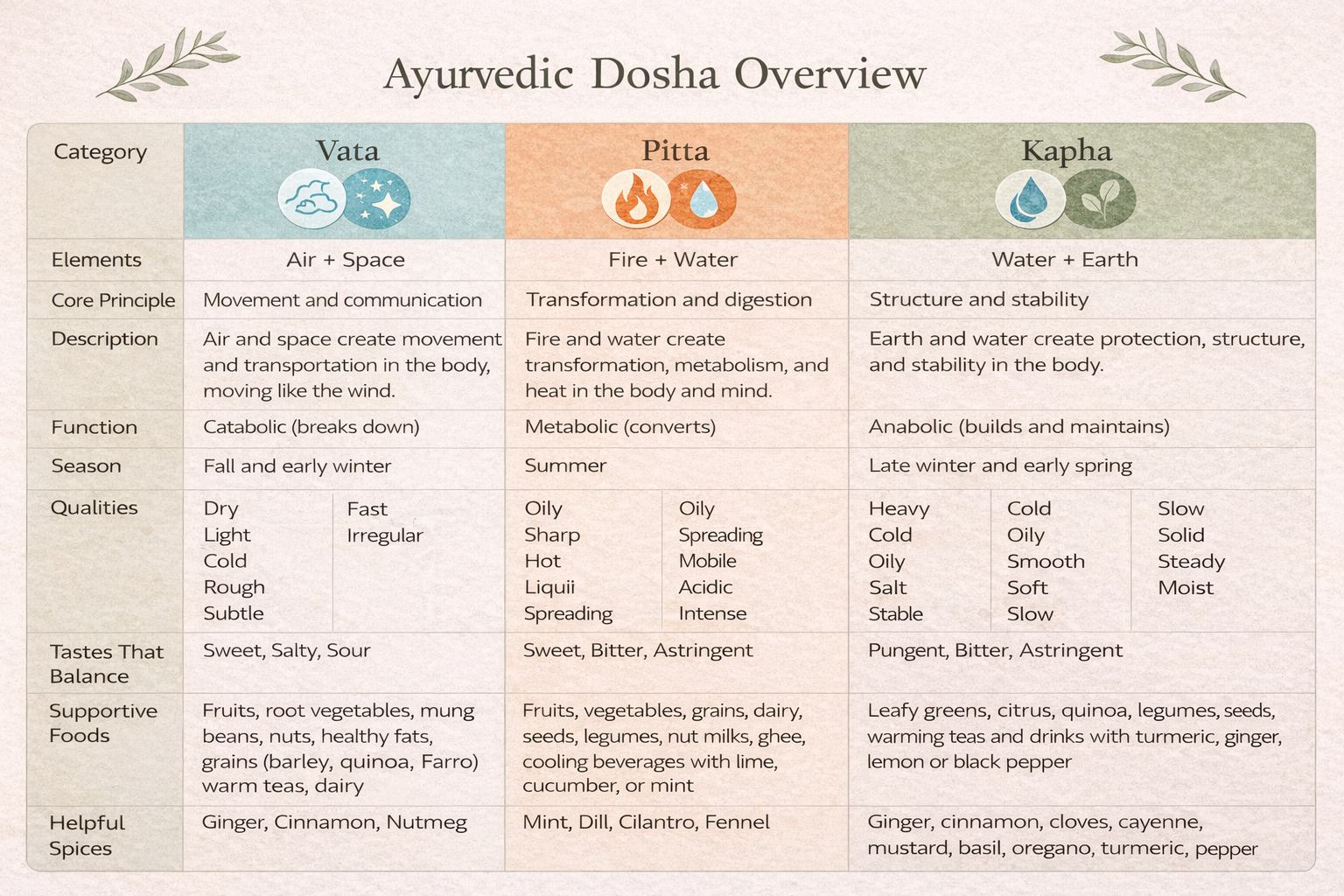
Quick Dosha Guide
Understanding the Law of Opposites
When working toward balance, Ayurveda encourages individuals to support their Vikruti, or current imbalance, rather than focusing solely on their natural constitution.
This brings us to one of Ayurveda’s most practical principles: the Law of Opposites.
The Law of Opposites states that like increases like, and opposites restore balance.
This concept applies not only to food but also to lifestyle habits, emotions, and daily routines.
For example:
If life feels fast and chaotic, the body benefits from slowing down.
If digestion feels sluggish, it benefits from stimulation and warmth.
If thoughts feel sharp or judgmental, they benefit from softness and calm.
Examples within diet include:
Vata (cold and dry) benefits from warm, moist, grounding foods
Pitta (hot and sharp) benefits from cooling, calming foods
Kapha (heavy and damp) benefits from light, warming foods
The same principle applies emotionally:
Vata anxiety calms with routine and reassurance
Pitta intensity softens with space, nature, and play
Kapha stagnation improves with novelty, connection, and movement
Balance rarely comes from doing more of what we prefer. Instead, it comes from choosing what restores equilibrium.
Simple Ayurvedic Guidelines to Begin
If you are new to Ayurveda, these foundational habits can help support digestion and overall balance:
Eat three meals daily and avoid constant snacking
Make lunch your largest meal
Eat dinner earlier and lighter
Sip warm beverages throughout the day
Avoid leftovers older than 36 to 48 hours
Minimize heavily processed foods
Walk after meals to support digestion
Support digestion with spices such as ginger, cumin, or cardamom
Maintain regular sleep habits of about eight hours per night
Incorporate exercise, yoga, meditation, or breathwork
Modern science increasingly confirms what Ayurveda has long taught: digestion influences mood, clarity, immunity, and energy.
A Gentle Beginning
This article is simply an introduction to Ayurveda. The tradition is vast, with many areas worth exploring.
Meaningful change happens through small and consistent adjustments that gradually improve quality of life.
Ayurveda is not about doing everything perfectly. It is about building a relationship with your body, your food, your environment, and the rhythms of nature.
Start by noticing where imbalance may exist in your life. From there, small adjustments can gradually guide you back toward equilibrium.
Expect to see Ayurveda-inspired recipes shared across my social media channels and here on the recipe page of Mmm-chelle’s Mindful Morsels. These practices have made a meaningful difference in my own life, and I look forward to sharing them with you.
We will continue exploring Ayurveda in future articles so that each of us can adopt the practices that best support our individual path toward balance, but in the meantime if you would like more information on Ayurveda and how your Doshas impact your life please check-out, “What is Ayurveda? A Complete Beginner’s Guide to Principles, Doshas & Healing” at The Ayurvedic Institute.
